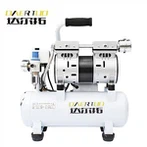
The rotary vane vacuum pump can pump out the dry gas in the sealed container, and if it is equipped with a gas ballast device, it can also pump out a certain amount of condensable gas. But it is not suitable for pumping gas with high oxygen content, corrosive to metal, chemical reaction to pump oil, and particulate dust.
Rotary vane vacuum pump is one of the most basic vacuum obtaining equipment in vacuum technology. Rotary vane pumps are mostly medium and small pumps. There are two types of rotary vane vacuum pumps: single-stage and double-stage. The so-called two-stage is to connect two single-stage pumps in series in structure. Generally, it is made into two-stage to obtain a higher degree of vacuum.
The relationship between the pumping speed of the rotary vane pump and the inlet pressure is stipulated as follows: when the inlet pressure is 1333Pa, 1.33Pa and 1.33×10⁻¹ (Pa), the pumping speed shall not be lower than 95% of the nominal pumping speed of the pump, respectively. 50% and 20%.
Rotary vane pump is mainly composed of pump body, rotor, rotary vane, end cover, spring and so on. A rotor is installed eccentrically in the cavity of the rotary vane pump. The outer circle of the rotor is tangent to the inner surface of the pump cavity (there is a small gap between the two). Two rotary vanes with springs are installed in the rotor slot. When rotating, centrifugal force and spring tension keep the top of the rotary vane in contact with the inner wall of the pump cavity, and the rotation of the rotor drives the rotary vane to slide along the inner wall of the pump cavity.