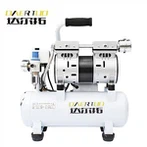
Silent oil-free vacuum pump is one of the common products of oil-free vacuum pump. Since sealing fluid is no longer used, and no vacuum oil needs to be added during operation, the quality of the discharged air is greatly improved. The noise is very small and does not cause any impact on the environment, so it is called a silent oil-free vacuum pump.
The silent oil-free vacuum pump is composed of stator, rotor, rotary vane, cylinder block, motor and other main parts. The rotor with rotating vanes is eccentrically installed in the fixed cylinder. When the rotor rotates at a high speed, the gas enters the filter muffler through the intake pipe for filtration to achieve a mute effect. The cavity is divided into four working chambers. Due to the action of centrifugal force, the rotary vane is close to the cylinder wall, separating the inlet and outlet of the stator, and it runs repeatedly to change the volume, and the inhaled gas is discharged from the exhaust port to achieve air extraction.
Silent oil-free vacuum pumps are widely used in the following work:
1) Vacuum chuck jig for processing non-magnetic parts.
2) The air tightness test of the surface of the object in a vacuum state.
3) High-efficiency vacuum filling of various liquids into bottles.
4) The supporting use of various medical machinery automatic lines.
5) Vacuum suction of paper on printing machinery.
6) Label vacuum suction and paste for cartons and bottles.
7) Photoplate under vacuum suction fixation.
8) Use pressure difference to guide gas analysis in vacuum state.
9) Vacuum forming of various plastic products.
10) The vacuum suction and pull column on the automatic packaging line open the bag and load the material.
11) Vacuum distillation and drying in Chinese and Western Medicine Factory.
12) Application on food processing machinery.
13) Leak detection test of various containers in vacuum state.
14) Vacuum suction in hospital operating room.
15) Gas analysis and physical and chemical experiments in universities, research institutes, factories and mines.
16) The supporting use of various medical instruments, etc.