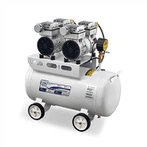
Rotary vane vacuum pump (referred to as rotary vane pump) is an oil-sealed mechanical vacuum pump. Its working pressure range is 101325~1.33×10⁻²(Pa), which belongs to low vacuum pump. It can be used alone or as a backing pump for other high vacuum pumps or ultra-high vacuum pumps. It has been widely used in the production and scientific research departments of metallurgy, machinery, military industry, electronics, chemical industry, light industry, petroleum and medicine.
The rotary vane pump can pump out the dry gas in the sealed container. If it is equipped with a gas ballast device, it can also pump out a certain amount of condensable gas. But it is not suitable for pumping out the gas with high oxygen content, corrosive to metal, chemical reaction to pump oil and particulate dust.
Rotary vane pump is one of the most basic vacuum obtaining equipment in vacuum technology. Rotary vane pumps are mostly small and medium-sized pumps. There are two types of rotary vane pumps: single-stage and double-stage. The so-called double-stage is to connect two single-stage pumps in series in structure. Generally, it is made into double-stage to obtain higher vacuum degree. The relationship between the pumping speed and the inlet pressure of the rotary vane pump is as follows: when the inlet pressure is 1333Pa, 1.33Pa and 1.33×10⁻¹ (Pa), the pumping speed value shall not be lower than 95% of the nominal pumping speed of the pump, 50% and 20%.
The rotary vane pump is mainly composed of pump body, rotor, rotary vane, end cover, spring, etc. A rotor is eccentrically installed in the cavity of the rotary vane pump, the outer circle of the rotor is tangent to the inner surface of the pump cavity (there is a small gap between the two), and two rotary vanes with springs are installed in the rotor groove. During rotation, the top of the rotary vane is kept in contact with the inner wall of the pump chamber by centrifugal force and the tension of the spring, and the rotor rotates to drive the rotary vane to slide along the inner wall of the pump chamber.
The two rotary vanes divide the crescent-shaped space enclosed by the rotor, the pump chamber and the two end covers into three parts, A, B, and C, as shown in the figure. When the rotor rotates in the direction of the arrow, the volume of the space A communicating with the suction port is gradually increasing, and the suction process is in progress. And the volume of the space C communicated with the exhaust port is gradually shrinking, and it is in the process of exhausting. The volume of the central space B is also gradually reduced, and is in the process of compression. Since the volume of space A is gradually increased (ie, expanded), the gas pressure is reduced, and the external gas pressure at the inlet of the pump is stronger than the pressure in the space A, so the gas is sucked in.
When space A is isolated from the suction port, that is, it turns to the position of space B, the gas begins to be compressed, the volume gradually shrinks, and finally communicates with the exhaust port. When the compressed gas exceeds the exhaust pressure, the exhaust valve is pushed open by the compressed gas, and the gas is discharged into the atmosphere through the oil layer in the fuel tank. The purpose of continuous pumping is achieved by the continuous operation of the pump. If the exhausted gas is transferred to another stage (low vacuum stage) through the air passage, it is pumped away by the low vacuum stage, and then compressed by the low vacuum stage and then discharged into the atmosphere, which constitutes a two-stage pump. At this time, the total compression ratio is borne by two stages, thereby increasing the ultimate vacuum.